
How the Digital SAT Adaptive Test Works: A Complete Breakdown for Students
The Digital SAT introduced a major shift in the way students are evaluated: an adaptive testing model that adjusts question difficulty based on your performance. Understanding how the digital SAT adaptive test works is essential, because the structure of the test directly influences your score, your pacing, and your preparation strategy.
In this guide, you’ll learn exactly how this adaptive system functions, why the College Board adopted it, and what it means for your test-day experience.

- What Does It Mean That the Digital SAT Is an Adaptive Test?
- How the Digital SAT Adaptive Test Works: The Two-Module Structure
- 1. Module 1: The Starting Point for All Students
- 2. Module 2: The Real Adaptive Shift
- 3. Timing and Question Distribution
- 4. Why the College Board Uses an Adaptive Model
- 5. A Simple Way to Understand the Adaptive System
What Does It Mean That the Digital SAT Is an Adaptive Test?
To understand how the digital SAT adaptive test works, you first need to know what “adaptive” means. Unlike the old paper SAT—where every student answered the same set of questions—the digital version adjusts itself in real time. This is done using a stage-based model built on Item Response Theory (IRT), which measures ability not just by how many questions you answer correctly, but also by which questions you get right.
The result: a shorter, more efficient exam that still produces highly accurate scores.
How the Digital SAT Adaptive Test Works: The Two-Module Structure
The new SAT uses a two-module format for each section. This is the core of how the digital SAT adaptive test works, and understanding it can help you prepare smarter.
Each section—Reading and Writing, and Math—contains:
- Module 1: the same for every test taker
- Module 2: adapts to your performance in Module 1
This modular design allows the system to identify your skill level quickly and assign questions that best measure your academic strength.
1. Module 1: The Starting Point for All Students
Module 1 includes an intentional mix of easy, moderate, and challenging questions. Its purpose is diagnostic: it evaluates your initial performance to determine which version of Module 2 you will receive.
During this stage of how the digital SAT adaptive test works, the system makes no assumptions about your ability. Everyone begins in the same place, giving the algorithm a fair and accurate baseline.
2. Module 2: The Real Adaptive Shift
Module 2 is where the adaptive design becomes visible.
- If you perform well in Module 1 → you are placed into a more challenging Module 2
- If your performance is moderate or low → you receive a less difficult Module 2
Both versions include a mix of question difficulties, but the overall average is higher or lower depending on your placement. This structure is a crucial part of how the digital SAT adaptive test works, because the difficulty of Module 2 directly affects the scoring potential of your section.
In simple terms: higher-difficulty modules open the door to higher possible scores.
3. Timing and Question Distribution
Here’s how the exam is structured:
| Section | Time | Questions |
|---|---|---|
| Reading & Writing | 64 minutes | 54 questions |
| Math | 70 minutes | 44 questions |
| Total | 2h 14m | 98 questions |
Within each module you may:
- move forward and backward
- review flagged items
- change answers
- skip and return
But once a module ends, you cannot reopen it.
This flow is designed to support fairness and accuracy while maintaining the efficiency of how the digital SAT adaptive test works.
4. Why the College Board Uses an Adaptive Model
There are several reasons why the adaptive system was chosen:
- Efficiency: fewer questions are needed to measure ability
- Precision: IRT models determine your score more accurately
- Shorter test: reduced testing fatigue
- Fairness: each student receives material appropriate to their level
This adaptive approach also ensures that test security is stronger, since students are no longer seeing identical question sets.
Understanding how the digital SAT adaptive test works gives you an advantage: you’ll know exactly why the exam feels shorter yet remains highly accurate.
5. A Simple Way to Understand the Adaptive System
Imagine the SAT like a two-level game:
- Level 1 (Module 1): everyone plays the same opening stage
- Level 2 (Module 2): the game selects an easier or harder path based on how well you performed in Level 1
This analogy captures the essence of how the digital SAT adaptive test works: the exam becomes more personalized as you progress.
Learn More about the SAT:
Digital SAT Desmos Calculator: The Ultimate Guide & Hacks for 2026
The transition to the Digital SAT has changed the rules of the game, making the...
Digital SAT Words in Context: The Ultimate Guide for 2026
Mastering Digital SAT Words in Context is no longer about memorizing obscure dictionaries. Since the...

PSAT/NMSQT: Your Complete Guide to College Preparation
The PSAT/NMSQT has officially gone digital, offering students a more streamlined, focused, and accessible testing...
How the Digital SAT Adaptive Test Works: A Complete Breakdown for Students
The Digital SAT introduced a major shift in the way students are evaluated: an adaptive...
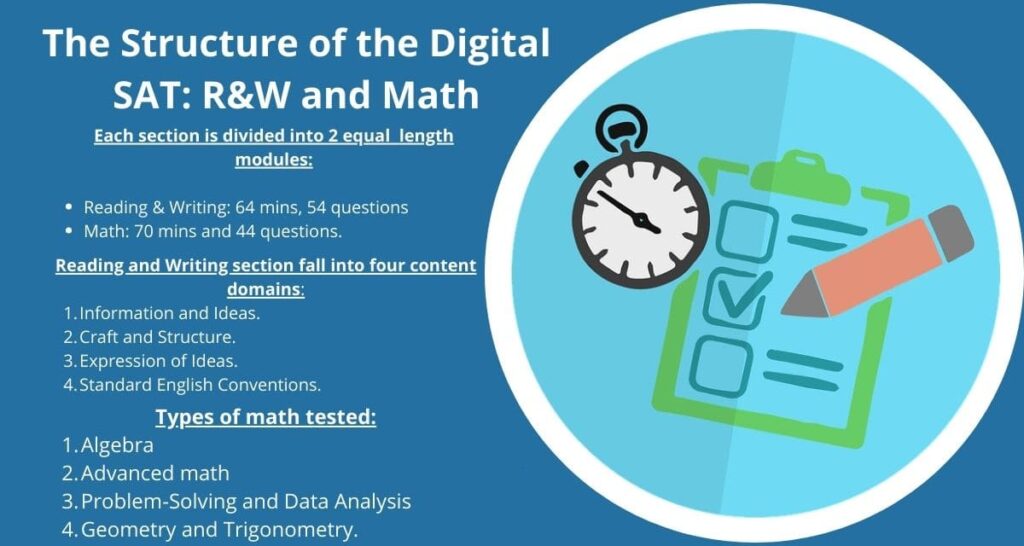
The Structure of the Digital SAT: R&W and Math
The Structure of the digital SAT comprises two sections: Reading and Writing, and Math. Students...
Leave a Reply