
PSAT/NMSQT: Your Complete Guide to College Preparation
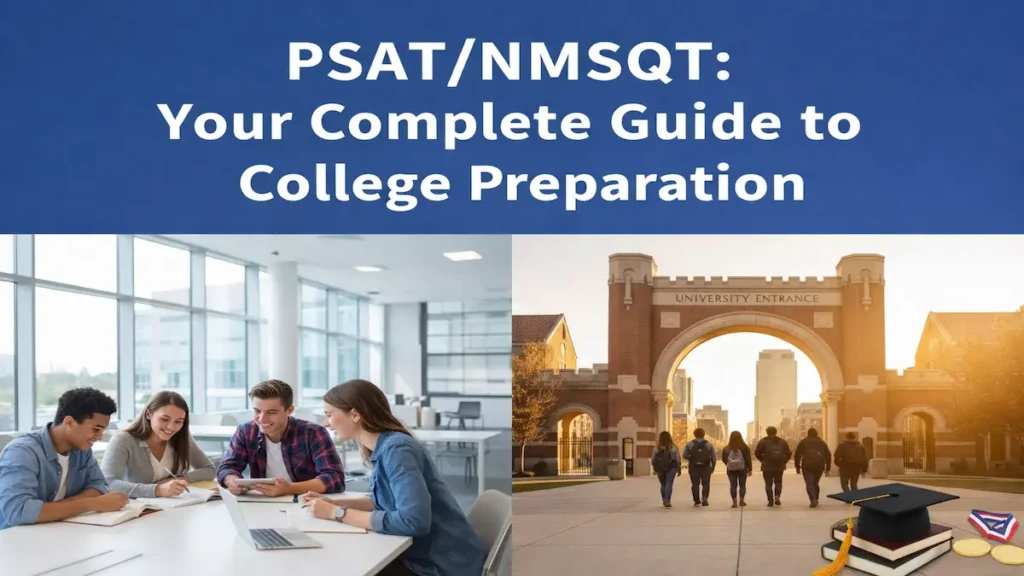
The PSAT/NMSQT has officially gone digital, offering students a more streamlined, focused, and accessible testing experience. While it is often described as a “practice SAT,” the PSAT/NMSQT plays a unique role in college preparation and scholarship opportunities.
If you are preparing for college—or helping your child plan ahead—this guide explains what the PSAT/NMSQT is, what it’s used for, how it’s structured, and why it matters.
- What Is the PSAT/NMSQT?
- What Is the PSAT/NMSQT Used For?
- PSAT/NMSQT vs SAT: Key Differences
- Who Should Take the PSAT/NMSQT?
- PSAT/NMSQT Test Format (Digital)
- PSAT/NMSQT Structure Overview
- Reading and Writing Section Explained
- PSAT/NMSQT Vocabulary: What to Expect
- Math Section Overview
- PSAT/NMSQT Scoring Explained
- PSAT/NMSQT and the National Merit Scholarship Program
- Is the PSAT/NMSQT Worth Taking?
- PSAT/NMSQT FAQs: Scores, National Merit, and College Admissions
What Is the PSAT/NMSQT?
PSAT/NMSQT stands for Preliminary SAT / National Merit Scholarship Qualifying Test.
It is a standardized exam administered in the United States by the College Board, in partnership with the National Merit Scholarship Corporation (NMSC).
In simple terms, the PSAT/NMSQT serves two main purposes:
- It acts as an early diagnostic version of the SAT
- It is the qualifying test for the National Merit Scholarship Program
What Is the PSAT/NMSQT Used For?
The PSAT/NMSQT provides a two-fold benefit for high school students.
College Readiness Assessment
The PSAT/NMSQT mirrors the format, skills, and content areas of the SAT, focusing on:
- Reading and Writing
- Math and quantitative reasoning
Taking the PSAT/NMSQT allows students to:
- identify strengths and weaknesses early
- become familiar with standardized testing expectations
- prepare strategically for the SAT
Scholarship Qualification
High PSAT/NMSQT scores may qualify students for the National Merit Scholarship Program, one of the most prestigious academic scholarship competitions in the United States.
PSAT/NMSQT Test Dates and Score Release Dates - HERE!
PSAT/NMSQT vs SAT: Key Differences
Although the exams are related, they serve different roles.
| Feature | PSAT/NMSQT | SAT |
|---|---|---|
| Purpose | Practice & scholarship qualification | College admission |
| Difficulty | Slightly easier | More challenging |
| Score Range | 320–1520 | 400–1600 |
| Sent to Colleges | No | Yes |
| Scholarships | National Merit only | Institutional & merit-based |
The PSAT/NMSQT is diagnostic, while the SAT is decisive.
Who Should Take the PSAT/NMSQT?
The PSAT/NMSQT is typically offered to:
- 10th-grade students (practice and preparation)
- 11th-grade students (official National Merit qualification)
Some schools also offer:
- PSAT 8/9 for younger students as an early introduction
International students may take the PSAT/NMSQT for practice purposes, but they are not eligible for National Merit scholarships.
PSAT/NMSQT Test Format (Digital)
The PSAT/NMSQT is a fully digital exam taken on a computer.
It uses a module-based adaptive format, meaning:
- each section is divided into two modules
- the difficulty of the second module depends on performance in the first
The exam includes two main sections:
FOLLOW US ON FACEBOOK
- Reading and Writing
- Math
Total testing time is approximately 2 hours and 14 minutes.
PSAT/NMSQT Structure Overview
| Section | Time (minutes) | Questions |
|---|---|---|
| Reading and Writing | 65 | 44 |
| Math | 70 | 44 |
| Total | 134 | 98 |
Both sections are weighted equally, emphasizing balanced academic readiness.
Reading and Writing Section Explained
The Reading and Writing section assesses college-level literacy skills, including:
- comprehension of short passages
- analysis of ideas and arguments
- command of evidence
- grammar and language conventions
- clarity and effectiveness of written expression
Skill Domains Tested
- Craft and Structure – understanding purpose, tone, and vocabulary in context
- Information and Ideas – analyzing central ideas, evidence, and data
- Standard English Conventions – grammar, punctuation, and usage
- Expression of Ideas – improving clarity, organization, and style
Each passage is paired with a single focused question, encouraging precision rather than memorization.
PSAT/NMSQT Vocabulary: What to Expect
The PSAT/NMSQT does not test obscure or advanced vocabulary.
Instead, it emphasizes:
- commonly used academic words
- vocabulary in context, not isolation
A strong vocabulary helps students:
- read faster and more confidently
- reduce guessing
- improve overall comprehension
Focusing on frequently used college-level words is far more effective than memorizing rare terms.
Math Section Overview
The Math section measures quantitative reasoning and problem-solving skills essential for college and career readiness.
Content Domains
- Algebra – linear equations, systems, inequalities
- Advanced Math – quadratics, exponentials, polynomials
- Problem-Solving and Data Analysis – ratios, percentages, statistics
- Geometry and Trigonometry – angles, triangles, circles, volume
Approximately 30% of questions are set in real-world contexts, requiring students to apply math concepts rather than perform routine calculations.
PSAT/NMSQT Scoring Explained
PSAT/NMSQT scores range from 320 to 1520.
Important points to remember:
- scores are not sent to colleges
- results are used for diagnosis and planning
- score reports help predict potential SAT performance
Unlike the SAT, PSAT/NMSQT scores are intended to guide preparation, not determine admissions outcomes.
PSAT/NMSQT and the National Merit Scholarship Program
Students who take the PSAT/NMSQT and meet eligibility requirements outlined in the official Student Guide may qualify for the National Merit Scholarship Program.
Key points:
- only 11th-grade U.S. students are eligible
- selection is based on a Selection Index, not the total score
- international students are not eligible, even if they take the test
Is the PSAT/NMSQT Worth Taking?
The PSAT/NMSQT is a valuable tool for:
- early SAT preparation
- understanding academic strengths and weaknesses
- exploring scholarship opportunities
- building confidence with digital standardized testing
While it does not affect college admissions directly, it plays a crucial role in strategic college planning.
Solve PSAT/NMSQT Practice Test 1 Online - HERE!
PSAT/NMSQT FAQs: Scores, National Merit, and College Admissions
What is PSAT and NMSQT?
The PSAT/NMSQT (Preliminary SAT / National Merit Scholarship Qualifying Test) is a standardized exam administered by the College Board. It serves as both a practice test for the SAT and the qualifying exam for the National Merit Scholarship Program. It helps students assess college readiness and identify academic strengths and weaknesses.
Does a 1400 PSAT qualify for National Merit?
A 1400 PSAT score alone does not automatically qualify a student for National Merit. Qualification is based on the Selection Index, which varies by state and year. In many states, semifinalist cutoffs are typically higher than a 1400, but the exact threshold depends on statewide performance.
Is the PSAT/NMSQT harder than the SAT?
No. The PSAT/NMSQT is slightly easier than the SAT. It covers similar skills and content but with a narrower difficulty range and a lower maximum score. The PSAT is designed as preparation, while the SAT is used for college admissions.
What is a good PSAT/NMSQT score?
A good PSAT/NMSQT score depends on grade level and goals. Generally:
Above 1000 is above average
1200+ is strong
1350+ is very competitive
Scores in the upper range may indicate readiness for high SAT performance.
What is an Ivy League PSAT score?
There is no official “Ivy League PSAT score.” However, students aiming for Ivy League schools typically score 1300 or higher on the PSAT, which often correlates with SAT scores competitive for selective universities.
Is a 1480 on the PSAT good?
Yes. A 1480 on the PSAT is an exceptional score. It places a student among the top scorers nationally and is typically competitive for National Merit Semifinalist consideration, depending on the state cutoff.
Can I get into Harvard with a 1480 SAT?
A 1480 SAT score is within the competitive range for Harvard, but admission is not guaranteed. Ivy League admissions consider multiple factors, including GPA, coursework rigor, extracurricular activities, essays, and recommendations.
Is 1450 top 1%?
A 1450 SAT score typically places a student in approximately the top 3–4% nationally, not the top 1%. The exact percentile varies slightly by testing year.
- Digital SAT Desmos Calculator: The Ultimate Guide & Hacks for 2026
- Digital SAT Words in Context: The Ultimate Guide for 2026
- PSAT/NMSQT: Your Complete Guide to College Preparation
- SAT Calendar Dates and Deadlines: August 2025 –June 2026
- Digital SAT Test Score Calculator 2025 – Convert Raw Scores
- How the Digital SAT Adaptive Test Works: A Complete Breakdown for Students

Leave a Reply